The Moss Manual / Taxon entry
Fissidens sp. 'Mini Taiwan' / 'Mini Nobilis'
'Mini Taiwan' & 'Mini Nobilis'
Sold in the aquarium hobby as ‘Mini Taiwan’, this exceptionally small moss forms compact, discrete tufts rather than extensive creeping mats. Its flattened, feather-like shoots and closely arranged leaves give it a distinctive miniature appearance.
Although initially investigated as Taxiphyllum cf. alternans, subsequent microscopy revealed characters consistent with the genus Fissidens, including distichous leaf arrangement, vaginant laminae and a single costa.
Its precise species identity remains unresolved.
Fissidens
Fissidentaceae
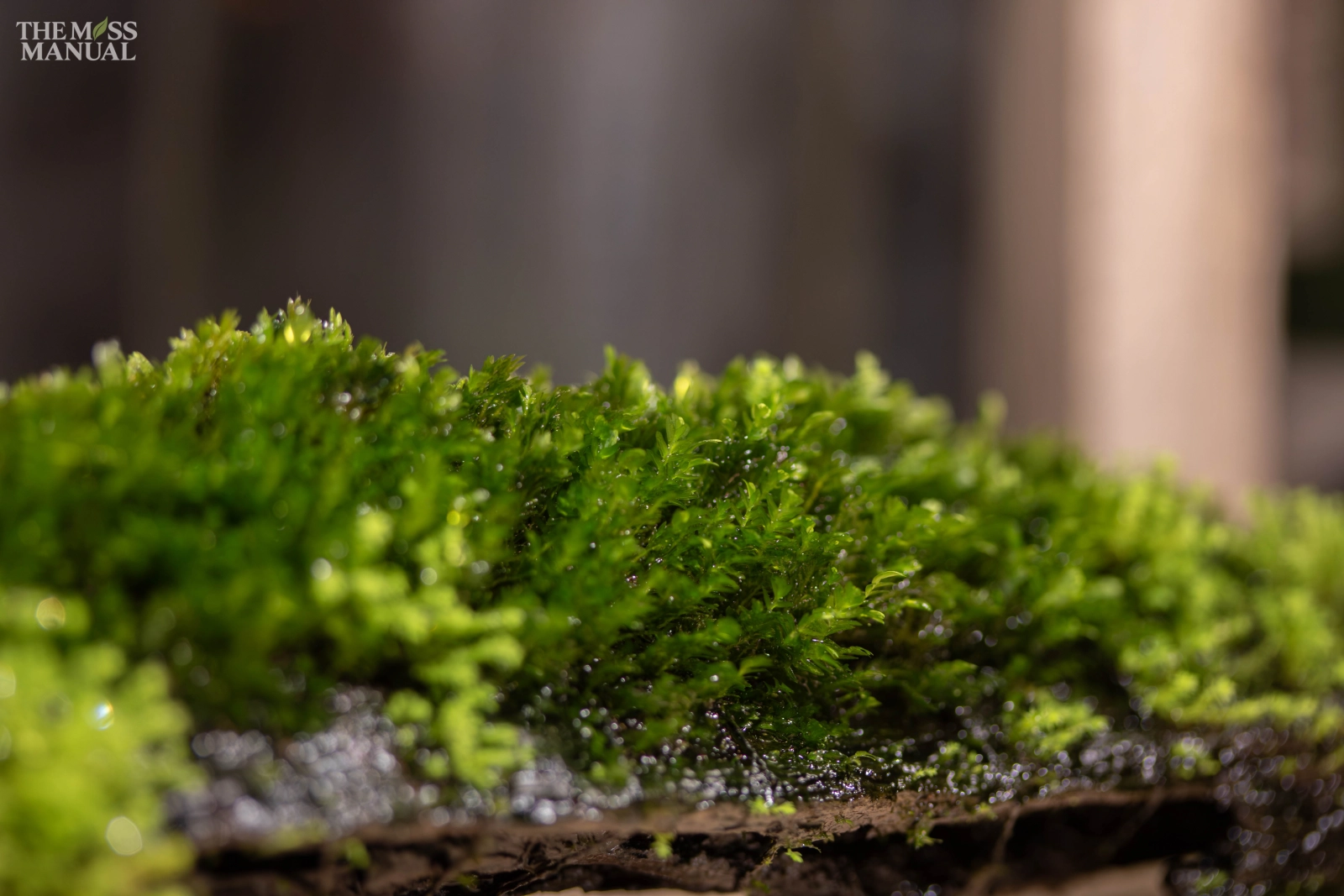
Fissidens sp. ' Mini Taiwan/Nobilis' colony of driftwood
View original colony photograph ↗01 / What you’ll see
At a glance
Fissidens sp. ‘Mini Taiwan’ forms compact, discrete tufts approximately 4–6 mm tall. Its miniature shoots exhibit a distinctly flattened, feather-like appearance, with closely spaced leaves spreading in two opposing ranks. The foliage is predominantly green, with overlapping, narrowly lanceolate leaves tapering towards acute tips. Despite its diminutive size, the plant displays a remarkably orderly, delicate architecture, particularly when viewed under magnification.
Growth habit
Discrete, compact tufts
Growth environment
Submerged and Emersed
Texture & density
Dense, finely textured foliage with closely packed, overlapping leaves.
Branch geometry
Short, flattened, feather-like shoots with a distinct two-dimensional appearance.
Leaf posture
Closely spaced leaves spreading laterally in two opposing ranks, forming a delicate, miniature fan.
02 / Conditions in cultivation
Parameters
Cultivation guidance from the documented observations; see the notes for context.
Temperature
18
–
26
°C
pH
6
–
7.5
GH
2
–
10
°dGH
KH
0
–
6
°dKH
Lighting
Low to moderate
CO₂
Recommended
Flow
Gentle to moderate
Parameters are based on a combination of known parameters for Fissidens species, and observed conditions for this species. Most dwarf species are slow (glacial) growing forms, and CO2 supplementation and stronger lighting are recommended to ensure optimal growth.
Fissidens prefer the cooler end of the temperature spectrum, with many doing better between 20-24 degrees celcius.
03 / In the glass box
Cultivation & care
‘Mini Taiwan’develops as small, distinct tufts with closely arranged foliage. Its compactgrowth makes it suitable for detailed aquascaping, particularly where miniaturetextures are desirable.
Growth rate,attachment behaviour and responses to varying aquarium conditions require further documentation.
Most dwarf species are slow (glacial) growing forms, and CO2 supplementation and stronger lighting are recommended to ensure optimal growth.
Many Fissidens prefer the cooler end of the temperature spectrum, with many doing better between 20-24 degrees celcius.
04 / Under the microscope
The Nerdery
Important, because it isn’t easy to find elsewhere.
Microscopy
Microscopy reveals several characters supporting placement within Fissidens.
Vaginant laminae:Overlapping sheathing portions are visible in darkfield images. Differences inoptical density between the overlapping and exposed regions make the cellularboundaries particularly apparent.
Costa: A single costa extends towards the leaf apex, terminating at or shortly below it inexamined leaves.
Frond microscopy
Image to be added
Leaf microscopy
Image to be added
Leaf arrangement
Shoots exhibit a flattened appearance with leaves arranged in two opposingranks. Approximately seven discernible leaf pairs occur below the apical fan inexamined material.
Leaf shape
Oblong-lanceolate to lanceolate, with relatively broad blades gradually tapering to acute apices
Costa
Asingle costa extends towards the leaf apex, terminating at or shortly below itin examined leaves.
Cell notes
Laminal cells: Median cells are predominantly short-polygonal to rectangular, with measured examples approximately 8.0–14.5 × 4.5–11.2 µm. Most measured length-to-width ratios fall around 1.3–1.8.
Margins and basal cells: Leaf margins appear entire, with no conspicuously inflated alar cells observed.
05 / Current assessment
Nerd Verdict
This specimen I-005 was originally received under the name ‘Mini Taiwan’ on 19 December 2025 and initially investigated as Taxiphyllum cf. alternans.
Subsequent morphological observations prompted reassignment to Fissidens sp.
A comparison with specimen BA-002, traded as ‘Mini Nobilis’, revealed strong morphological similarities. The two trade names may represent conspecific material, but this relationship remains unconfirmed.
Historical aquariumtrade references also document the name Fissidens sp. ‘Mini Taiwan’,independently of the present specimen.
High
A convincing miniature Fissidens, with its species identity still an open question.
The combination of distichous leaves, vaginant laminae, a single costa and compact shoot architecture supports the current genus assignment.
The specimen alsodemonstrates why aquarium trade names should not be treated as reliabletaxonomic identifications.
How identifications are assessed
Identifications are assessed against biological reports and taxonomic descriptions, alongside specimen observations and microscopy. Sources are provided where possible. Independent verification is explicitly flagged where available.
Identification status
Confident ID (non-peer reviewed)
Independent verification
No
06 / Evidence & attribution