The Moss Manual / Taxon entry
Taxiphyllum sp
Flame Moss
A fine-leaved moss that grows vertically in tight, corkscrewing patterns that have been likened to flickering green flames.
Taxiphyllum
Hypnacaeae
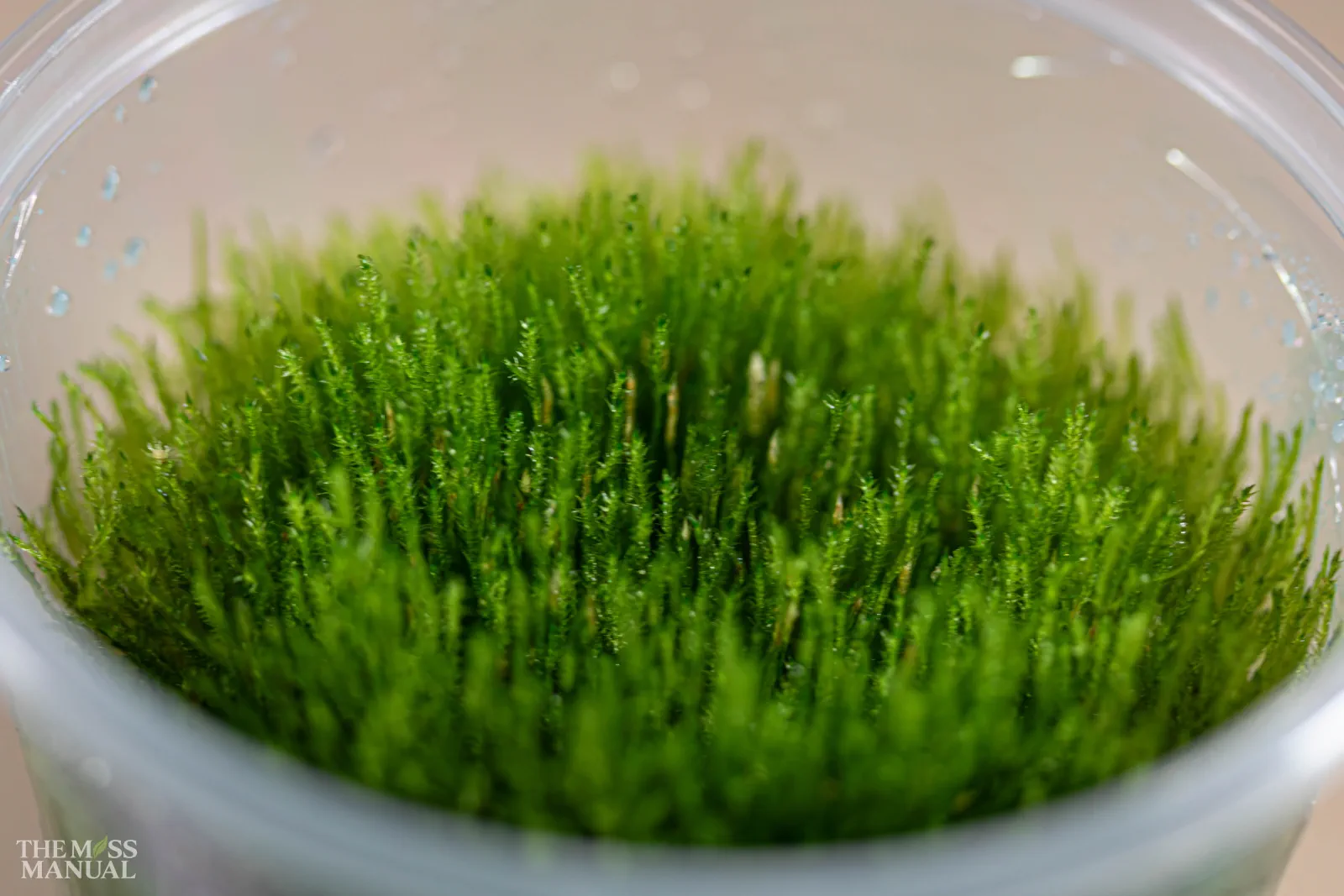
Colony photograph
Image to be added
Taxiphyllum sp 'Flame' in-vitro
View original colony photograph ↗01 / What you’ll see
At a glance
Flame Moss grows predominantly upwards, producing slender, wiry shoots that twist gently around their own axes. Established growth forms dense clusters of vertical stems, creating a characteristic flame-like appearance. The twisting habit is particularly noticeable where individual shoots rise above the surrounding growth.
The foliage remains closely arranged against the stems, giving the shoots a compact, almost braided appearance rather than the flattened, feathery presentation associated with many other aquarium mosses. Lateral feathering is minimal, with the overall structure dominated by tightly arranged, ascending primary shoots.
The combination of upright growth, subtle corkscrew rotation and compact foliage provides a useful macroscopic distinction from many commonly cultivated Taxiphyllum and Vesicularia forms.
Growth habit
Erect to ascending, with characteristic torsional growth.
Growth environment
Submerged and Emersed
Texture & density
Dense, wiry and springy, forming compact vertical clusters.
Branch geometry
Tight, vertically oriented primary shoots with subtle corkscrew rotation and little lateral feathering.
Leaf posture
Appressed to strongly imbricate, closely overlapping along the stems.
02 / Conditions in cultivation
Parameters
Cultivation guidance from the documented observations; see the notes for context.
Temperature
18
–
28
°C
pH
6
–
8
GH
2
–
15
°dGH
KH
0
–
10
°dKH
Lighting
Low to moderate
CO₂
Optional
Flow
Gentle to moderate
The ranges above represent general aquarium husbandry recommendations rather than experimentally established physiological tolerances for Taxiphyllum sp. 'Flame'. They should not be interpreted as absolute survival limits or species-specific optima.
The specimen record does not currently include controlled cultivation trials establishing preferred water chemistry, lighting intensity or dissolved CO₂ requirements.
03 / In the glass box
Cultivation & care
Flame Moss is well suited to attachment to aquarium hardscape, including driftwood, stone and other stable surfaces. Its upright growth makes it particularly useful where vertical texture is desired. Small portions can be secured with thread or suitable aquarium-safe adhesive until the moss establishes itself.
Low to moderate lighting is generally sufficient for cultivation, although growth rate and density may vary with light availability and overall nutrient conditions. Supplemental CO₂ is not considered essential, but may encourage more vigorous growth where other conditions are favourable.
Gentle to moderate water circulation helps prevent suspended detritus from accumulating within dense clusters. Excessively compact growth may trap debris, particularly near the base, so occasional gentle cleaning is beneficial.
Propagation is achieved through division or trimming of established shoots. Cut portions can be reattached to new surfaces, while selective thinning helps maintain the characteristic upright appearance and prevents older growth from becoming excessively congested.
04 / Under the microscope
The Nerdery
Important, because it isn’t easy to find elsewhere.
Microscopy
Frond microscopy
Image to be added
Leaf microscopy
Image to be added

Direct macroscopic observations
The specimen exhibits strongly upright growth, with compact primary shoots displaying subtle corkscrew rotation. The overall structure is dense, wiry and springy, with little apparent lateral feathering.
This combination produces a distinctive flame-like submerged phenotype.

Direct microscopic observations
Leaves are closely overlapping and strongly imbricate, without a clearly flattened arrangement. Individual leaves appear lanceolate to ovate-lanceolate, with slightly acute tips and apparently entire, undulate margins.
No distinct costa is visible in the current in-vitro material.
Leaf arrangement
Leaves are strongly imbricate, overlapping closely along the stem. The foliage presents as tightly arranged around the shoot rather than forming a clearly complanate, flattened plane.
The compact arrangement contributes to the distinctive narrow, twisted appearance of the shoots.
Leaf shape
Leaves are lanceolate to ovate-lanceolate, tapering towards slightly acute apices.
The margins appear entire, with noticeable undulation. The degree to which this undulation reflects intrinsic leaf morphology or curvature within the mounted material has not yet been established.
Costa
Absent
Cell notes
Laminal cells are predominantly linear to narrowly vermicular, markedly elongated along the longitudinal axis of the leaf. Cells are closely packed in broadly parallel rows, with some curvature and divergence towards the margins and tapering apices.
Individual cell boundaries are clearly resolved, particularly within the median and distal lamina. Cell width appears relatively uniform, while cell length varies across the visible tissue. No conspicuous band of differentiated median cells is apparent.
Basal and alar cell differentiation could not be reliably assessed due to overlapping foliage and obscured leaf bases. Quantitative cell measurements remain pending.
Observations are based on in-vitro material and may not fully represent the cellular morphology of mature submerged growth.
05 / Current assessment
Nerd Verdict
Moderate
How identifications are assessed
Identifications are assessed against biological reports and taxonomic descriptions, alongside specimen observations and microscopy. Sources are provided where possible. Independent verification is explicitly flagged where available.
Identification status
Tentative Working ID
Independent verification
No
06 / Evidence & attribution